Pages

Sunday, November 17, 2013

Work in Progress

We though you might be interested in an update on the Dynamic Green Home. We've got much, but not all, of the planting and landscaping done. The contractor's obviously making progress on the exterior. (Interior shots come next month.) For a construction site, despite some litter, it's pretty clean and organized. No, the fact that the building is now red doesn't mean it's not a green project. Our green is more than skin deep. 
Credit board
Credit Board
New siding
New siding
House wrap under siding
Over house wrap
Mulch awaiting installation
East side yard serviceberries
Hydrangia
Hydrangia
Retaining wall and patio to be

Monday, November 4, 2013

DGH Paint Partner

Dynamic Green Homes (DGH) is delighted to have Hirshfield’s as a Community and Education Partner and a material donor. Through their partnering in the DGH, Hirshfield’s is broadening their corporate engagement with the neighborhood. More about Hirshfield’s role can be found in this video. If you join us on December 7, you’ll get a “hands-on” opportunity to learn more about how Hirshfield’s products can help you green both the DGH and your own home.
picture of Hirshfield's products

Throughout its history, Hirshfield’s Paint Manufacturing (HPM) has been committed to delivering quality products, formulated with the selection of raw materials that are safe for the environment, safe for their customers, and safe for their employees. Being environmental stewards has always been important to Hirshfield’s operational objectives, as demonstrated in the following:

• Hirshfield’s manufacturing facility operates a closed loop reprocessed water system. All wash water used in clean-up process and in the purging of manufacturing equipment is re-used.

photo of closed loop system

• Their facility is designated and in compliance with being a very small quantity generator of hazardous waste (solvents). HPM is committed to a program where less than 200 gallons of waste solvent is generated annually.

• Recycling of all cardboard and paper products generated in manufacturing process.

• Refitting of facility lighting system that conserves 76,000 kwh of power annually. (That’s equivalent to the total electricity consumed each year by about 100 Minnesota homes.)

photo of lighting system

• Hirshfield’s products can help meet green building criteria such as the United States Green Building Council’s LEED® certification.

• Hirshfield’s collects all dust-like particles generated in the manufacturing process with dust collectors and recycles all filtered dust particles, preventing airborne contaminant from entering into the environment.

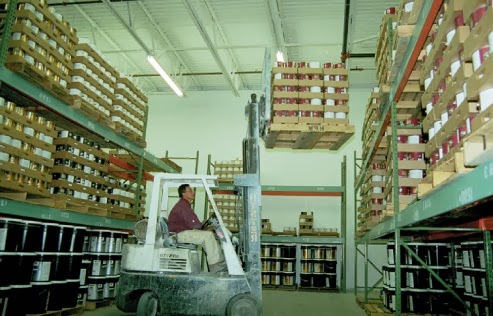
• They have converted all forklifts used within the manufacturing facility to battery packs, eliminating all trucks which ran on fossil fuels.

photo of converted forklift

• The utilization of non-toxic raw materials throughout all of Hirshfield’s Paint Manufacturing’s formulation base. As examples, Hirshfield’s avoids using carcinogenic chemicals such as crystalline silica, and Ethylene Glycols.

• They manage a container return program and recycle totes and recycle drums.

For additional environmental preservation please look for Hirshfield’s “green choice

Monday, October 21, 2013

ReGENerating Rain Gardens (Part 2)


This week, in Part 2 of the landscape and rain garden summary, we're going to take a close look at the proposed plantings, donated by Dragonfly Gardens, for the front yard and the east side yard. (The narrow side yard on the west side of the house is becoming a french drain.) Here's a schematic of the front yard. Samuel Geer of reGEN Land Design, our Education Partner for the rain garden, and a member of the Emerging Professionals of the Minnesota Chapter of the USGBC, provided the design and list of materials. You can see that there are fewer species and total plants (depending on the number of Hostas) that we're using in the rain garden.

Below is a listing of Common Names, Latin Names and number of plants for the front and east side yard. The Common Names have links to additional information. [Depending on availability at planting time, there may be some species substitutions, but all plantings will be native.] Please plan on joining us October 26 to learn more about using these beautiful native plants in your own landscaping plan and to see the hands-on installation of a rain garden and French drain. 
Topics to be Covered include:
• Low maintenance landscape design
• Design with native species and horticultural varieties.
• Invasive species control
• On-going maintenance
Proposed Plantings
(front and east side)
Number
Latin
Common
12
Amelanchier alnifolia 'Regent'
Regent Serviceberry
many
Hosta spp. (mixed)
Mixed Hosta
4
Aronia melanocarpa 'Autumn Magic'
'Autumn Magic' Chokeberry
1
Cornus hessi 'Garden Glow'
Garden Glow Dogwood
When you come, please remember that parking is on-street so car pool, bike or walk, if you can. Here's a map link to 929 Edmund, in case you need it.

Monday, October 14, 2013

ReGENerating Rain Gardens

This week we're going to take a close look at the proposed plantings, donated by Dragonfly Gardens, for the back yard and rain garden. Next week we'll get to the front and side yards. Here's a schematic of the back yard. Samuel Geer of reGEN Land Design, our Education Partner for the rain garden, and a member of the Emerging Professionals of the Minnesota Chapter of the USGBC, provided the design and list of materials.

Although we're not going for LEED for Homes certification with this project, it's worth noting that one of the Sustainable Sites prerequisites is "no invasive plants." Minnesota Green Communities has a similar requirement. We did some quick checking and were pleased to find [as expected] that the backyard species are predominantly native Minnesotan and none could be found on invasive species lists. (We were unable to find a single, free, definitive list of Minnesota invasive species on-line.) Below is a listing of Common Names, Latin Names and number of plants for the back yard. The Common Names have links to additional information. [Depending on availability at planting time, there may be some species substitutions, but all plantings will be native.] Please plan on joining us October 26 to learn more about using these beautiful native plants in your own landscaping plan and to see the hands-on installation of a rain garden and French drain.
Topics to be Covered include:
• Low maintenance landscape design
• Design with native species and horticultural varieties.
• Invasive species control
• On-going maintenance

Proposed Plantings 

Number Latin Common
1 Aronia melanocarpa Iriquois Beauty Chokeberry
36 Carex Pennsylvanica Pennsylvania Sedge
3 Eupatorium dubium "Little Joe" Joe Pye Weed
13 Iris versicolor Blue Flag Iris
12 Panicum virgatum Shenandoah Switchgrass
13 Rudbeckia fulgida 'Goldsturm' Black Eyed Susan
3 Perovskia atriplicifolia Russian Sage
1 Amelanchier x grandifolia Autumn Brilliance Serviceberry
6 Diervilla lonicera Dwarf Bush Honeysuckle
9 Calamagrostis-acutiflora-karl-foerster Feather grass
1 Hydrangea paniculata Hydrangea
Here's a map link to 929 Edmund, in case you need it. 

Monday, October 7, 2013

Green building, healthy community

This past June, on the 28th to be specific, USGBC National released “Health is a Human Right. Green Building Can Help.” The emphasis on the relationship between green building and human health is a close to perfect fit for the work we’re doing with the Greater Frogtown Community Development Corporation on our Dynamic Green Home. The linkage between health and affordable housing has been recognized for quite a few years. Reduction or elimination of lead paint hazards, ensuring radon levels are within guidelines and asbestos is remediated are all priorities. Reducing asthma triggers and indoor air quality contaminants are getting increased attention compared to just a few years ago. We were particularly heartened to find the following statement in the report:
“We must shift practice such that our definitions of sustainable building include the well-being of the people in the buildings and the community around them as a matter of course – not an incidental byproduct. In the new paradigm, human performance must be seen as important as energy performance; health conservation equal to water conservation; health management on par with waste management. And we must ground our choices in data, using research and evidence to inform our approaches to healthy design, construction and maintenance. It’s through this holistic approach that green building becomes not just a market transformation tool, but a human transformation tool as well.” 
photo of 929 Edmund (front, before)
929 Edmund (before)
It’s encouraging to see this kind of holistic approach because we already know of a number of studies indicating that health problems disproportionately affect those with lower incomes living in substandard housing. Furthermore, The Center for Housing Policy and Enterprise, a leading developer of Green Communities criteria, in a report published in 2007, found that “Well-constructed and managed affordable housing developments can reduce health problems associated with poor quality housing by limiting exposure to allergens, neurotoxins and other dangers.” That same report concluded “Use of green building and transit-oriented development strategies can lower exposure to pollutants by improving the energy efficiency of homes and reducing reliance on personal vehicles.” Our DGH efforts seem to be right in line with these findings. Be sure to attend one of our upcoming seminars to see how you can improve where you live with healthy options.

Monday, September 30, 2013

Dynamic Green = Healthy Home

A big part of the impetus for USGBC-MN’s involvement with the Dynamic Green Home initiative comes from the chapter’s commitment to social and environmental justice. Poor housing conditions and energy inefficiency have a disproportionate impact on low and moderate-income families. That means that green building and sustainable development provide a greater return on investment for those living in affordable housing.

You probably know there’s a National Center for Healthy Homes. Those folks have brought us the Seven Principles of Healthy Homes: A Healthy Home is
  1. Dry 
  2. Clean 
  3. Pest-Free 
  4. Safe 
  5. Contaminant-Free 
  6. Ventilated 
  7. Maintained 
I think these principles offer a useful framework through which to look at the work being done to rehabilitate the Dynamic Green Home at 929 Edmund Street. Lets start with a quick overview. OK?

photo of 929 Edmund St., front
929 Edmund        © harrington

DRY: The yard is going to be landscaped and a rain garden added. This will help move moisture away from the foundation. Some of the improvements are called for by Minnesota’s Building Code, others are best (or at least better) practices from stormwater management and landscape design.

CLEAN: Part of this will come from the application of Integrated Pest Management (prevention rather than extermination), part from the new owner’s efforts to keep food stored properly and the renovated kitchen clean of food residues.

PEST-FREE: Some of the work that Greater Frogtown CDC will be having done includes repair and/or replacement of windows and siding. Sealing openings will limit entrances for pests.

SAFE: The kitchen redesign and bringing stairs up to code will help make the house safer.

CONTAMINANT-FREE: Here’s where a lot of effort is going to be focused. The house has had a lead paint assessment; lead paint remediation and containment will be done. Radon, the second leading cause of lung cancer, will be mitigated and asbestos will be remediated. VOCs (which can trigger asthma and cause cancer) will be reduced by using low VOC paint and building materials. Why is all this so important?
According to USEPA Region 1, an “…average American spends approximately 90 percent of their time indoors….studies of human exposure to air pollutants by EPA indicate that indoor levels of pollutants may be 2 to 5 times – and occasionally more than 100 times – higher than outdoor pollutant levels. Indoor air pollutants have been ranked among the top five environmental risks to public health.”
VENTILATED: New exhaust systems and fans will be installed in the bathroom(s) and kitchen. The house uses radiators so there’s no ducting for forced hot air.

MAINTAINED: The rehabilitation and renovation will catch up deferred maintenance and minimize major maintenance requirements for the new owners for the first few years.

On behalf of the DGH development team, we’d love it if you would join us at one of the upcoming seminars. If you do, you’ll have an opportunity to see many of the improvements that are being made besides those covered in the seminar. It could give you some great ideas for making your own home healthier and more energy efficient.

Tuesday, September 24, 2013

Dates to Save: Dynamic Green Seminars

October 26: Landscape
December 7: Painting Primer 
December 14 BEING RESCHEDULED: Foundations of Flooring

It’s been a long, long time since I’ve run a floor sander; not so long since I’ve painted a room; and I’ve never designed or planted a rain garden. Flooring refinishing is often done by homeowners, although I did a lot of floor refinishing when I was a renter in Boston years ago. Painting skills are useful for renters and homeowners. Rain garden design and development, using local, non-invasive species,  is more and more worth knowing for just about all us Minnesotans. So, I’m looking forward to refreshing old skills and learning new ones at three upcoming Dynamic Green Home Seminars
Each of them is on a Saturday, starts at 9 a.m. and lasts about an hour and a half. Each provides information you could use whether you're a a homeowner or a renter. They'll all be held at our Dynamic Green Home pilot at 929 Edmund St., St. Paul. The first one is just a few weeks away. See you there?

photo of interior of 929 Edmund
Interior of 929 Edmund (before)

Limited parking is available on street. Please walk or bike if you can.
On Saturday, October 26, again starting at 9 a.m. and continuing for about an hour and a half, we’re scheduled to look at The Dynamic Green Home: Landscape with Sam Geer of reGEN Land Design. reGEN Land Design has created a beautiful, low-maintenance, eco-friendly design for our Dynamic Green Home at 929 Edmund.
Back Yard of 929 Edmund Street (before)

The landscaping seminar will cover:
  • Rain garden design and installation
  • Low maintenance landscape design
  • Permeable paving systems
  • Design with native species and horticultural varieties. 
  • Invasive species control
The seminar will include the hands on installation of the rain garden plantings by workshop attendees. 
On December 7, Phil Kirkegaard (Certified Energy Manager, Minnesota Licensed Building Contractor and LEED AP), and Cindy Martimo (Principal Instructor, Interior Design at Dunwoody College of Technology) plus a representative from Hirshfield's, our Community and Education partner, will take about an hour and a half, starting at 9 a.m., to conduct a Painting Primer and walk us through these topics:
  • Low VOC and alternative paint options
  • Color selection – making your paint job last
  • Basic painting 101: how to, cutting in, taping, dry-lock and moisture management, dealing with lead 
The seminar will be followed by a volunteer work weekend completing the interior painting of the home. Come to learn, stay to help and practice what you just learned.
On December 14 CHECK BACK FOR NEW DATE we’ll be doing the Foundations of Flooring Seminar at the usual 9 a.m. for an hour and a half. Phil,  Heather and Cindy will be back. This time they’ll be cluing us in on:
  • Healthy, sustainable flooring options: Hardwood vs. Carpet, Linoleum no-no’s
  • Refinishing hardwood
  • What to do when your flooring squeaks
  • Options for making your hardwood last: maintenance,
    painting hard wood
 Please join us for one or more of these events. Learn from others and about what we’re doing to make 929 Edmund, Greater Frogtown, St. Paul, the Twin Cities and Minnesota greener, healthier, and more sustainable.